Labour rules
The organisation chooses enforcement; legal value, unit, source and effective date are system-managed and must not be edited like an internal preference.
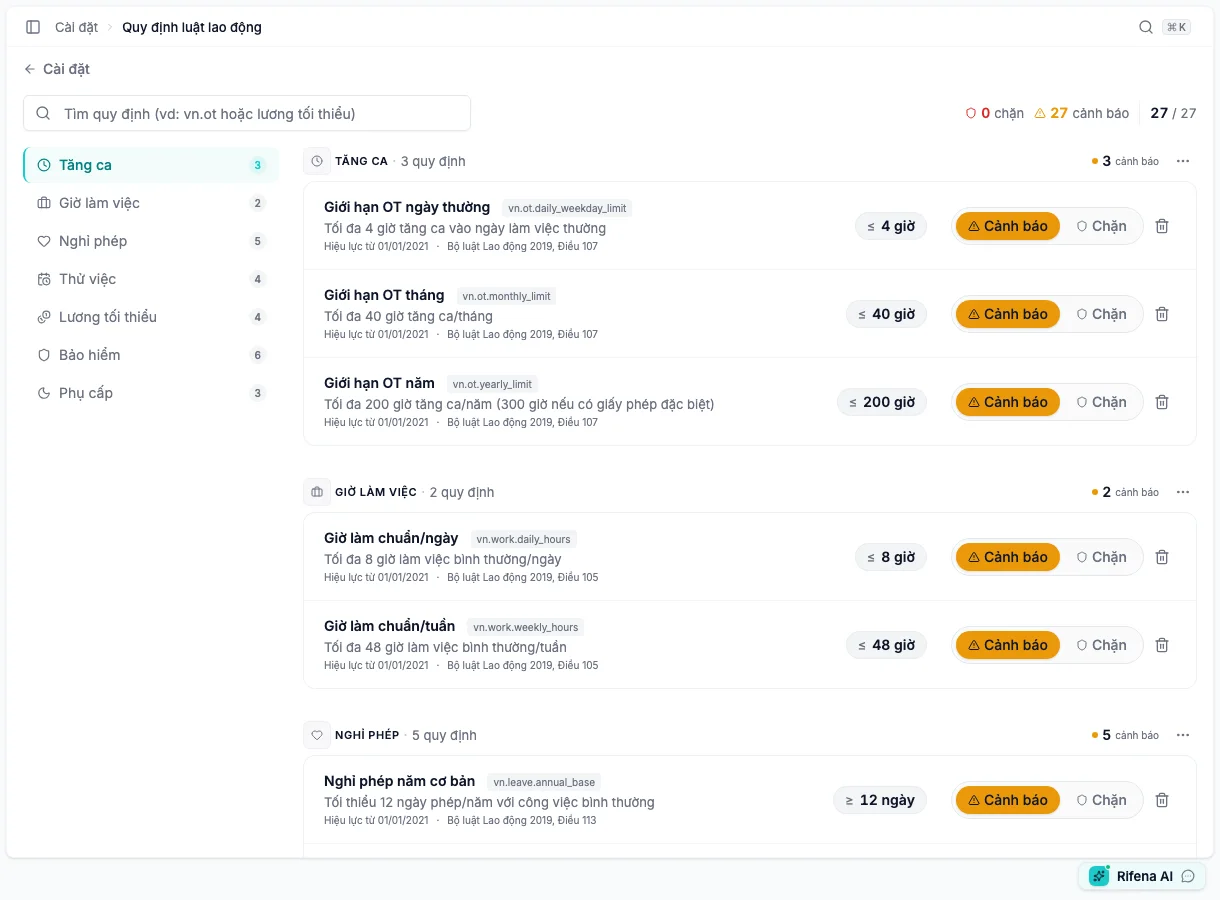
Seven rule categories
- overtime;
- working hours;
- leave;
- probation;
- minimum wage;
- insurance;
- allowances.
Use search or category navigation. If a category has no appropriate rule for the current effective date/jurisdiction, do not copy a value from old documentation.
Two information layers
System-managed
Rule name/code, value, unit, legal source, effective date and supported legal scope are read-only so an organisation cannot redefine a legal value.
Organisation-selected
- Warn
- Shows risk while an authorised person may continue after review.
- Block
- Prevents completion of a violating action; read confirmation before broad use.
- Remove
- Stops this organisation's application without deleting the system-library rule.
Add or change rules
- Choose Add rule when the library still contains unapplied entries.
- Read category, source, effective date and value.
- Select Warn for observation or Block after operations are ready.
- Save and verify the rule in its category.
- Test one compliant and one violating case.
Bulk selection can Warn, Block or Remove multiple rules. A bulk result can be partial; keep successful rows and retry only failures after fixing their cause. Use Undo while available for an accidental change, then reopen the rule.
Different from attendance Compliance
- Labour rules is the legal guardrail library and Warn/Block selection.
- Operations → Compliance manages attendance-violation rules, cases and statistics.
- A compliance reference amount must not become an automatic wage deduction.
When an action is missing
- No Add rule: every available rule is applied or the account is view-only.
- Legal value is not editable: expected system ownership.
- Partial bulk result: keep successful rows and resolve each remaining reason.
See Compliance and Time policies.